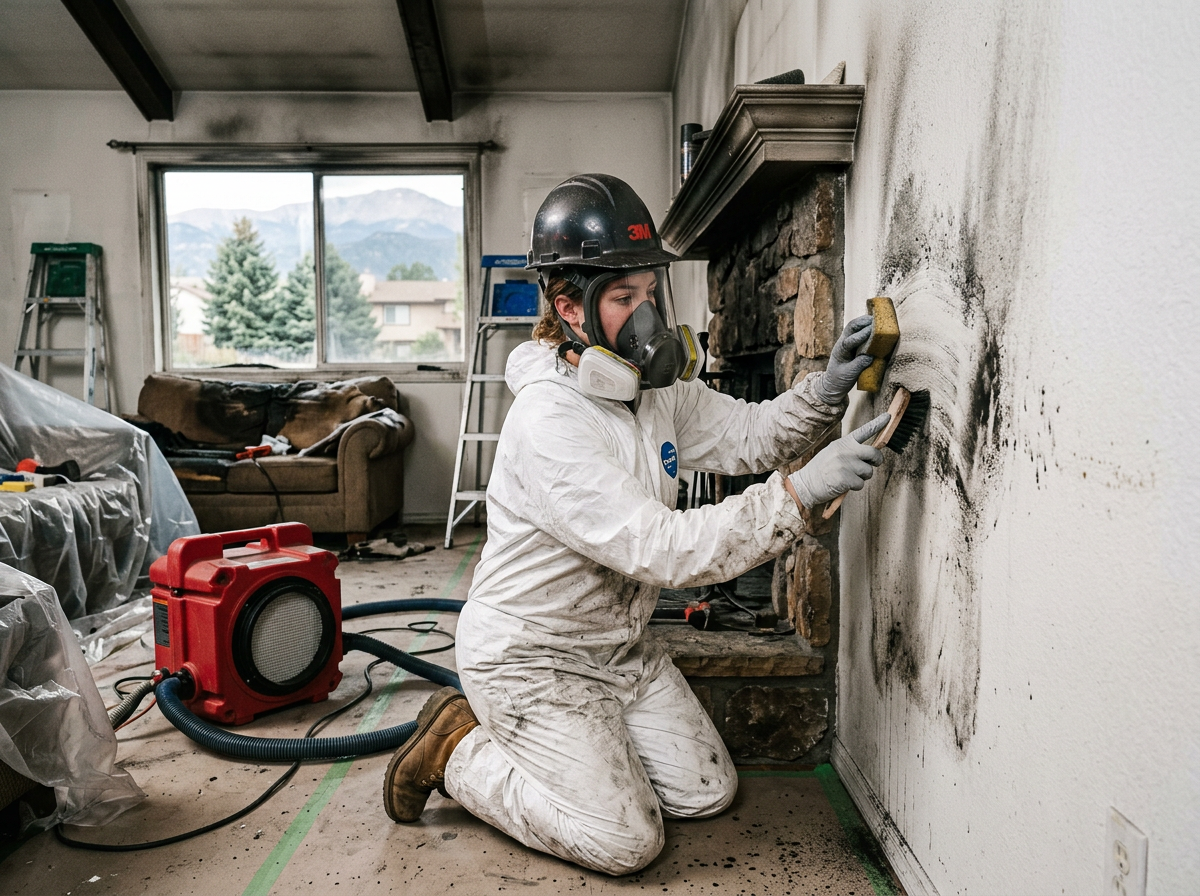
Soot from Colorado Springs structure fires mixes with suppression water that must be removed first to prevent setting residues into porous surfaces. At 6,035 feet, combustion produces finer, more alkaline particles that bond differently to drywall, insulation, and wood framing than lower-elevation soot. Technicians test pH on-site and select alkaline or solvent-based cleaners accordingly; acidic soot from synthetic furnishings requires different agents than cellulosic smoke from older Security-Widefield homes. Dry air keeps particulates suspended, so containment and negative-air machines run continuously during removal.
HVAC systems in Briargate and Wolf Ranch homes often pull smoke through intakes and attic vents, depositing soot deep in ductwork and coils. Cleaning begins only after water extraction and moisture mapping confirm no active dampness that would reactivate residues. Fibrous materials such as carpet padding, unsealed drywall, and certain insulation cannot be saved once soot has penetrated because agitation releases particles back into the air. Contents are inventoried and separated by cleanability before any surface work starts.
Air-quality monitoring continues throughout because fine particulates remain airborne longer in the region’s low humidity. Technicians seal off affected zones with plastic sheeting and maintain negative pressure to protect unaffected rooms. Post-cleaning verification uses both visual inspection and particle counters rather than relying solely on odor detection. Homeowners receive written guidance on when to replace HVAC filters and how to ventilate without reintroducing outdoor smoke during chinook wind events.
Pre-war Old North End properties present additional challenges with plaster and lath that trap soot in hidden voids. These cavities require targeted access points and HEPA vacuuming before sealing. Every job ends with a documented clearance that notes which surfaces were cleaned versus replaced, giving owners a clear record for insurance.
Technician insight
In Colorado Springs the thing that catches most people out with Soot Cleanup is assuming the job is finished once visible soot is gone; the dry air and altitude keep microscopic particles suspended and driven into insulation, so skipping the final particle-count verification leaves residue that reappears during the next chinook wind.
Security-Widefield tract home after electrical fire
Suppression water had already wicked into carpet padding and subfloor. After extraction and moisture mapping, technicians tested soot pH and used alkaline cleaners on the 1980s drywall while discarding saturated insulation. Negative air ran for two days to clear particulates that the dry climate kept airborne. The home passed clearance testing and reopened without odor return.
Soot Cleanup Services We Offer
✓HVAC Soot Extraction
Removes smoke particles from ductwork and coils after wildfire smoke enters through intakes, preventing re-circulation in Colorado Springs homes.
✓Drywall and Insulation Soot Removal
Cleans or removes soot-laden drywall and insulation where high-altitude residues have penetrated porous surfaces following structure fires.
✓Hard Surface Soot Cleaning
Applies pH-appropriate agents to wood, tile, and metal surfaces affected by alkaline or acidic soot from local fires.
✓Contents and Upholstery Soot Treatment
Separates, cleans, and deodorizes salvageable furnishings while documenting items that cannot be restored after smoke exposure.
✓Attic and Vent Soot Clearance
Targets soot that enters through roof vents and attic spaces common in Black Forest and Calhan properties during wind-driven smoke events.
Soot Cleanup Cost in Colorado Springs, CO
| Service | Typical Range | What Affects It |
|---|---|---|
| Single-room soot cleanup | $900–$1,800 | Varies with material porosity and need for drywall removal |
| Whole-home soot cleanup | $3,500–$7,500 | Includes multiple rooms and basic HVAC inspection |
| HVAC soot extraction add-on | $600–$1,400 | Depends on duct length and coil access |
| Contents cleaning | $400–$1,200 | Based on item count and cleanability |
Ranges are typical for Colorado Springs, CO and confirmed with an exact written quote before any work starts.
How it works
- 1
Initial Assessment And Water Extraction
Technicians inspect for active moisture from suppression water and extract it before any soot work begins.
- 2
Containment And Air Management
Zones are sealed and negative air is established to keep fine particulates from migrating through dry Colorado Springs air.
- 3
Residue Testing And Agent Selection
pH testing determines whether alkaline or solvent cleaners are required for the specific soot chemistry at altitude.
- 4
Surface And Cavity Cleaning
HEPA vacuuming, agitation, and appropriate cleaners remove soot from accessible and hidden surfaces.
- 5
Verification And Documentation
Particle counts and visual inspection confirm clearance before a written report is provided.
Pricing
Cost depends on affected square footage, residue depth, and whether HVAC or contents cleaning is required.