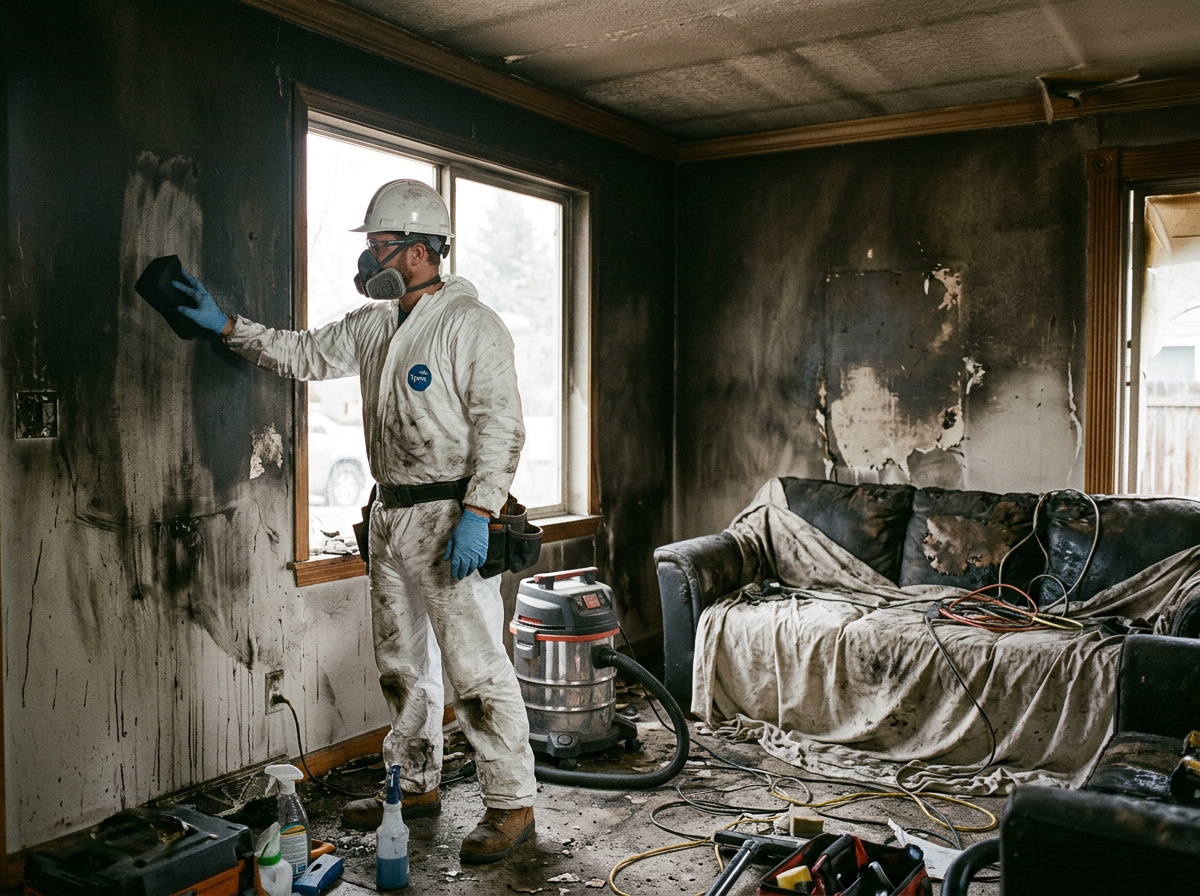
Smoke from Colorado Springs structure fires and nearby wildfires produces distinct residues that behave differently at 6,035 feet. Protein-based soot from kitchens requires alkaline cleaners, while synthetic residues from plastics and insulation need acidic or solvent-based agents to avoid setting the stain. Dry air keeps fine particulates suspended longer, driving them deeper into carpet pad, insulation, and unsealed drywall, so technicians must use negative-air machines with HEPA filtration before any wiping begins.
Suppression water is present in nearly every local fire call and must be removed first; standing moisture turns acidic soot into a corrosive slurry that etches metal and concrete. In Security-Widefield tract homes and newer Briargate builds, HVAC systems act as distribution networks, pulling smoke through returns and spreading it into every room. Attic vents and window seals on the lee side of chinook winds create concentrated pockets that standard surface cleaning misses.
Porous items such as upholstered furniture, acoustic ceiling tiles, and unsealed wood often cannot be saved once particulates penetrate the substrate; attempting to clean them releases fine soot back into the air. Air-quality testing before and after work confirms when particulate levels drop below safe thresholds, protecting occupants with respiratory conditions common in the dry Front Range climate.
Technicians sequence work from least to most invasive surfaces, starting with contents removal, followed by HVAC cleaning, then structural surfaces. This order prevents recontamination and accounts for the way high-altitude combustion creates more alkaline ash that bonds tightly to cool surfaces.
Technician insight
In Colorado Springs the thing that catches most people out with Smoke Damage Restoration is how quickly dry air and chinook winds push soot into the insulation and behind baseboards of 1970s Security-Widefield homes; if you start wiping surfaces before the HVAC and attic are sealed, you just keep moving the same particles around for days.
Smoke Infiltration in a Briargate Home
A homeowner noticed a persistent smoky odor two days after the Black Forest Fire. Inspection found soot had entered through the attic vents and HVAC return while the system ran. Technicians extracted no water but sealed and cleaned the ductwork, removed affected insulation, and treated the drywall with alkaline agents suited to the alkaline ash. Clearance testing confirmed safe particulate levels and the family returned without odor recurrence.
Smoke Damage Restoration Services We Offer
✓Wildfire Smoke Infiltration Cleanup
Removes fine particulate that enters through HVAC intakes, attic vents, and window seals during regional fires without any structure burn.
✓HVAC Smoke Residue Removal
Cleans ducts, coils, and blowers that have distributed soot throughout homes in Briargate and Wolf Ranch after nearby wildfires or structure fires.
✓Suppression Water Extraction
Removes standing and trapped water from every structure fire before soot cleaning starts to prevent corrosion and secondary mold.
✓Soot Removal From Porous Materials
Treats drywall, insulation, and carpet in older North End homes and Black Forest properties where dry air has driven particulates deep into substrates.
✓Post-Fire Odor Neutralization
Neutralizes smoke odors trapped in porous surfaces using methods suited to the altered combustion chemistry found at local altitude.
✓Contents Cleaning After Smoke Exposure
Cleans hard and soft goods that can be salvaged, separating items that have absorbed irreversible soot from those that can be restored.
Smoke Damage Restoration Cost in Colorado Springs, CO
| Service | Typical Range | What Affects It |
|---|---|---|
| Initial Assessment and Air Testing | Free | Includes moisture mapping and residue identification |
| HVAC Smoke Cleaning | $800–$2,200 | Depends on system size and number of returns |
| Whole-House Smoke Remediation | $2,500–$7,500 | Varies with square footage, water volume, and porous materials involved |
| Contents Cleaning | $600–$3,000 | Based on item count and whether items can be cleaned on-site |
Ranges are typical for Colorado Springs, CO and confirmed with an exact written quote before any work starts.
How it works
- 1
Initial Assessment and Air Testing
Technicians inspect for smoke entry points, test air quality, and identify residue types while noting any standing suppression water.
- 2
Water Extraction and Drying
All suppression water is removed and affected areas dried before soot work begins to avoid spreading corrosive residues.
- 3
Source Removal and HVAC Cleaning
Loose soot is captured with HEPA equipment; ducts and intakes are cleaned to stop re-distribution of particulates.
- 4
Surface Cleaning and Odor Treatment
Appropriate cleaning agents are applied by residue type, followed by odor neutralization on remaining surfaces.
- 5
Final Clearance Testing
Air quality is re-tested and surfaces inspected before contents are returned and the home is released for occupancy.
Pricing
Pricing varies by square footage affected, whether HVAC cleaning is required, and the volume of suppression water present.